This article explains the complete B2B order processing workflow in EasyEcom, from order creation through picking, packing, invoicing, and handover.
Use Case
B2B orders are used when goods are sold in bulk from one business to another. This article explains the complete operational workflow for processing such orders in EasyEcom.
Required Settings
Settings accessible from UI
1. Auto Assign Inventory For B2B Orders at order import
When enabled:
- Orders are automatically approved
- Inventory is auto-assigned to the order
Note:
- Order behavior after approval depends on inventory assignment (fully or partially assigned)
- Refer to "Order Approval" section for detailed behavior
2. Activate bulk SKU scanning at B2B Order processing
This setting will allow the user to add the quantities in bulk instead of scanning one by one
3. Auto Picker Assignment
When enabled, the system automatically assigns newly created picklists to logged-in pickers in a round-robin sequence.
Settings to be done from backend
For Handover
A default setting will be enabled "shipTogether":"2" This setting will allow the user to scan the consignment and then boxes one by one in the handover.
If user needs to scan box at handover then they can get this setting enabled "box_scan_at_handover":1
This setting will allow the user to scan the boxes on the handover page without scanning the consignment.
For Packing slip
"generate_packing_slip_after_invoice":1
When enabled, packing slip can be downloaded only after invoice generation.
Box Number and Box Count will be printed on the packing slip after invoice generation.
"generate_packing_slip_after_invoice":0
Packing slip is downloaded immediately after closing the box.
Box Number is printed at the time of packing (before invoice).
For Paper Picklist
"b2bPicklist":0
This setting will allow the user to print the picklist from the web
"b2bPicklist":1
This setting will disable the option to print the picklist from the web as HHT will be used in this case
Workflow
Order Creation & Approval
B2B order processing begins with order creation, followed by order approval and inventory assignment.
Use the following KBs for the detailed steps:
Step 1 – Create a B2B Order
Create a B2B order manually by entering the customer, order details, products, pricing, and other applicable information.
After the order is created, it must be approved and have inventory assigned before proceeding to picklist creation.
Depending on the Auto Assign Inventory For B2B Orders at order import setting, approval and inventory assignment may happen automatically or require manual action.
Once the order is approved and the required inventory is assigned, proceed with the remaining B2B order-processing workflow below.
Order Search, Status, Picking & HHT Flow
Video
Step - Go to Actions and click on Create Picklist
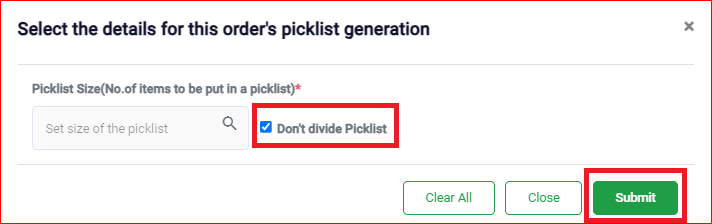
Step 2- Select Picklist Criteria
To divide the order into multiple picklists, keep the box unchecked and choose the zone to divide the picklist as per the zone and click on Submit
If you do not wish to divide the picklist, check the box and click on Submit
Incase of UoM inventory, user will not be able to select the size of the picklist
Once the details are submitted, the order will automatically get added to the batch.
Step 3 - Go to Order Batches B2B to view the batch.
You may also sort your batches according to the below mentioned filters. Click on More Filters and choose the filters according to your requirement.
Picker Assignment:
When Auto Picker Assignment is enabled, the system automatically assigns the picklist to a logged-in picker in a round-robin sequence. If no picker is available, the picklist remains unassigned.
When Auto Picker Assignment is disabled, the picker can be assigned manually from the Picker dropdown.
Pickers logged in through Web or Android are considered available for automatic assignment. A picker is removed from the assignment queue when they no longer have an active session.
Assign the Packer and print the picklist.
You may also bulk download the picklists.
Order Box Processing, Packing & Packaging Slip
Video
Step 4 - Pack the Order
Standard Workflow (Operational Type 0 & 2)
Click the Batch ID or go to Packing & Sorting and scan the Picklist ID.
OR
Step 5 - Once the picklist ID is scanned, you will get the option to Create Box
Step 6 - The box will be created and you will receive the Box ID with the barcode.
Step 7 - Scan the Box ID & thereafter scan the Product Code
You can scan items individually or, for Non-Serialized accounts, add quantities in bulk by enabling Activate bulk SKU scanning at B2B Order processing under Account Settings > Other Settings.
When bulk SKU scanning is enabled:
Scan the SKU, UPC, or UoM.
The Bulk SKU/UPC/UoM Scanning window opens.
Review the available product details and receiving batch code displayed in the window.
Enter the required quantity.
Click Submit to add the quantity to the box.
Note: If multiple expiry dates are available for the SKU, they are displayed as a comma-separated list.
Packing Progress
After scanning the Box ID and adding items to the box, the Packing Station displays the Picklist Overview on the right side of the screen.
The Picklist Overview helps the packer monitor the packing progress for the entire picklist while packing items into one or multiple boxes.
It displays:
SKU – SKU available in the picklist.
Assigned Qty – Total quantity assigned for the SKU in the picklist.
Packed Qty – Total quantity already packed across all boxes created for the current picklist.
Unpacked Qty – Remaining quantity that is yet to be packed.
The values are updated automatically as additional quantities are packed across all boxes for the current picklist.
You may add the quantities of SKU/EAN/UOM in bulk for Non-Serialized Account
Once all the quantities are scanned, all the items will be packed. Click on OK
Step 8 - Close the box
Closing the box is important so that the invoice can be generated.
Enter the box ID again and click on Proceed
Mention the dimensions and close the box (this is optional).
Box Number On closing a box, the system automatically generates a Box Number for that box. For each order, Box Number starts from 1 and increments sequentially as boxes are closed.
Box Number is generated only once, is mapped to the system-generated Box ID, and does not change.
Box Number is printed on the packing slip based on the configuration of "generate_packing_slip_after_invoice".
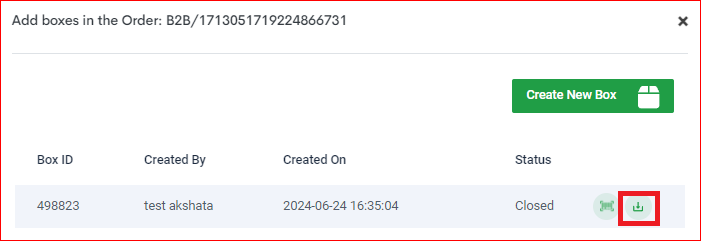
The generated Box Number is displayed in the View Boxes modal against the corresponding Box ID.
Packing Material
To use Packing Material for B2B orders, enable the "Activate B2B Packing Material" setting. (Settings > Other Settings)
Enable "Activate B2B Packing Material".
If you enable it, you will get the option to choose the packing material before closing the box.
Note- To add packaging material, please ensure that it has been created as a product first.
Add the packaging material for the order.
Step 9 - Packing Slip
As soon as the box is closed, packing slip will be auto downloaded. You may also click on View All Boxes and generate the packing slip manually.
Packing Slip Behaviour Based on Configuration
If "generate_packing_slip_after_invoice" = 0:
• Packing slip is auto-downloaded immediately after box closure.
• Box Number is printed below the Order Number at the time of packing.
If "generate_packing_slip_after_invoice" = 1:
• Packing slip can be downloaded only after invoice generation.
• Box Number and Box Count are printed after invoice generation.
• Box Number will not print on the packing slip before invoicing.
You may also generate the barcode of the box
For partially processed orders:
If some boxes are invoiced and some are not, Box Number printing follows invoice status.
System prints only closed and invoiced boxes when configuration is set to 1.
Invoicing & Handover
Video
Step 10 - Go to Start Invoicing
Start scanning the Box ID/IDs
If Skip Box Scanning During Invoicing is enabled, then after scanning the first box, click on View All Boxes. This will display all closed boxes associated with the order. Clicking Add To Consignment will add all closed boxes to the consignment at once. Or else, you can scan each box individually.
Once, all the boxes in the order are scanned or added in the consignment, click Generate Invoice
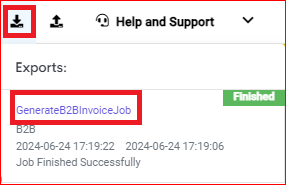
Check the Export Section to download the invoice
OR
Step 10a- Create Consignment
Go to Manage Consignment and click on Create Consignment
Select the order type as "Business Order" and Customer’s Name and click on Create
A Consignment ID will be created. Click on OK
Step 11 - Once the consignment is created, click on Action to start the invoicing
Step 12- Scan the Box ID
Scan the Box ID to add the box to the consignment.
If multi_box_scan_invoice is enabled, scan the first Box ID and click View All Boxes.
The system displays all closed boxes associated with the order.
Select the required boxes and click Add To Consignment.
All selected closed boxes will be added to the consignment at once.
If multi_box_scan_invoice is disabled, each Box ID must be scanned individually.
Notes
Only closed boxes are available for invoicing.
Boxes that are still open or have incomplete packing are not available for selection.
One consignment batch can contain a maximum of 5000 boxes.
Remove Box from Consignment
If a box is added incorrectly, click Remove Box and scan the Box ID again.
A confirmation popup will appear.
Select the checkbox and click Proceed.
The selected box will be removed from the consignment.
Bulk invoicing allows the users to scan multiple boxes and print the invoice in bulk
Note- One consignment batch can have a maximum of 5000 boxes
Step 13 - Generate Invoice
To generate the invoice once the box is scanned. Click on Generate You may find the invoice (+einvoice, if generated) in the export tab.
View Imports
Downloaded Invoice
The status of the consignment will be changed to Invoiced. To view the consignment, go to Actions and click on View Consignment
Step 14 - Generate Packing Slip
You may also generate the packing slip after invoicing which will also have the consignment number. Go to Action and click on Generate Pack slip post invoice (to enable the setting, please connect with EasyEcom support)
You may download the invoice or the consignment doc. Go to Actions and click on Downloads
Step 15 - Create Manifest
Go to Orders (main menu) > B2B Orders > Manage Handover.
Click on Create Handover and a handover batch will be created.
Step 16 - Scan Consignments
Go to Actions and click on Scan Consignment. You will get the option to scan consignment and then the scan boxes.
Note- One handover batch can have a maximum of 100 consignments.
With shiptogether2 & box at handover enabled
Step 17 - Add Shipping Info
Once the package is added to the handover, add the shipping information
Shipping Information
Once the consignment is added to the handover, shipping information must be updated before manifest generation.
Manual Shipping Information
Click Add Shipping Info and enter the required transportation details.
Save the details and proceed with manifest generation.
When ClickPost is Integrated
If ClickPost is integrated on the account, the Add Shipping Info option is replaced with Generate Shipment.
Users will see the following options:
Generate Shipment (ClickPost)
Generate Shipment (Manual)
Generate Shipment (ClickPost)
Select this option to generate the shipment through ClickPost.
Once the shipment is generated successfully, the button changes from Generate Shipment to Edit Shipping Info.
Users can then review or update the transportation details associated with the generated shipment before manifest generation.
Generate Shipment (Manual)
Select this option if shipment creation through ClickPost is not required and transportation details need to be entered manually.
Shipping information Note:
Shipping information is mandatory if:
the invoice value of an individual consignment is more than ₹50,000, or
the combined invoice value of all consignments in the same handover is ₹50,000 or more when Ship Together = 1 is used.
In such cases, the system generates an eWay Bill for each consignment in the handover.
Example:
Consignment
Invoice Value
C1
₹10,000
C2
₹20,000
C3
₹30,000
Total handover value: ₹60,000
Result
eWay Bill is generated for C1.
eWay Bill is generated for C2.
eWay Bill is generated for C3.
Click on Generate Manifest
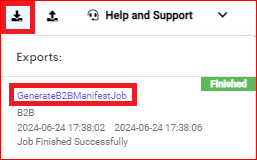
Manifest will be downloaded in the View Exports tab
Downloaded Manifest
Auto Batch Closing
Scenario 1: When all orders within a batch are shipped and the manifest is created, the system will automatically close the batch.
Scenario 2: When all orders within a batch are cancelled, the system will automatically close the batch.
Scenario 3: When an order has both shipped and cancelled items, and the manifest is generated, the system will automatically close the batch.
In the above image, out of 20 suborder items, 5 suborder items are in "Manifested" stage and 15 suborder items are in cancelled. Hence, the system closed the batch automatically.
Scenario 4: When the order is partially shipped and partially packed, the system will not close the batch automatically but user will get the option to close the batch manually
In the above image, out of 20 suborder items, 5 suborder items are in "Manifested" stage and 15 suborder items are in "Pack Started" stage. In this case, the system will not close the batch, but user can close the batch manually.
To view all the shipped orders, go to Orders (main menu) > B2B Orders > View Orders > Shipped Orders. Set the date filter and click on Submit
3PL Complete Workflow Video
FAQs
1. How many line items / SKUs are allowed in a B2B order? Currently, there is no limit of line items/ SKUs in B2B Orders.
2. Is shipping information required for all orders?
No. Shipping information is mandatory when:
- an individual consignment invoice value exceeds ₹50,000, or
- the combined invoice value of consignments in the same handover is ₹50,000 or more when Ship Together = 1 is used.
3. Does the new pricing master apply to international customers?
No, the new pricing master is currently not applicable to international customers. Additionally, the "calculate price from pricing master" option will not be available for international orders.
4. Can I add combo products when creating an order in the new B2B system? Currently, adding combo products directly while creating an order is not supported in the new B2B system.






 You may download the invoice or the consignment doc. Go to Actions and click on Downloads